I Took Ray Dalio's Personality Test, Here's What It Showed Me About Myself
I took Ray Dalio's free PrinciplesYou test, uploaded the results to Claude, and spent 20 minutes doing a deep analysis. Here's what it showed me about how I work, lead, and scale.
I first heard about PrinciplesYou on the My First Million podcast. Sam Parr and Shaan Puri, two entrepreneurs I’ve followed for a while, were sitting down with Ray Dalio himself (watch or listen to the episode; it’s worth it). Dalio talked about how he uses personality data to build teams at Bridgewater, and mentioned this free test he built that maps how you think, how you lead, and how you behave under pressure. I opened it the moment the episode ended.
Honestly, I wasn’t expecting much. I’ve taken enough personality tests to know most of them tell you something obvious wrapped in impressive language. You answer 30 questions, get called an INTJ or a Type 4, feel vaguely understood for a day, and then forget about it.
PrinciplesYou is different. Not because the results are more flattering. Because they’re more specific.
What The Test Actually Covers
The assessment takes about 20-25 minutes. It’s longer than most, and the questions are designed to catch you in contradictions. You’ll say you’re a systematic thinker in one section, then reveal something more impulsive three questions later. The test pays attention to those gaps.
It maps you across three dimensions.
Your cognitive orientation is how you prefer to think. Are you creative or methodical? Conceptual or practical? Do you solve problems by exploring possibilities or by applying structure?
Your interpersonal orientation is how you engage with people. Are you extraverted or more contained? Do you push back or pull people in? How nurturing are you, and how much do you want to lead?
Your motivational orientation is how you apply yourself. How composed are you under pressure? How autonomous? How persistent when things get hard?
Each dimension breaks into sub-scores with percentages, so you’re not just getting a label. You’re getting a map.
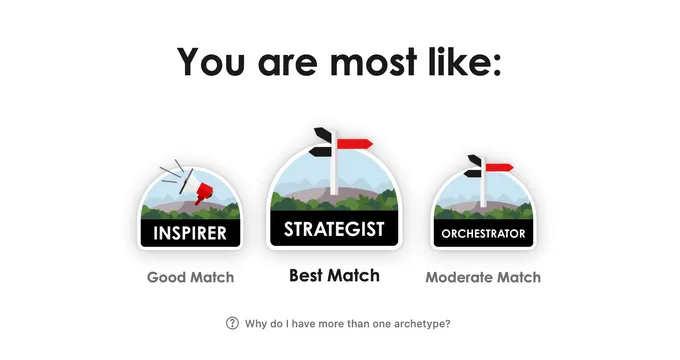
At the end, it assigns you one of several leadership archetypes. Mine came back as The Strategist (best match), The Inspirer (good match), and The Orchestrator (moderate match).
What It Produced For Me
The Strategist archetype fit immediately. Strategists gather data from multiple sources, make systematic assessments, translate vague problems into structured plans, and push those plans through to results. That’s how my brain works. I don’t like ambiguity for its own sake. I want to understand the situation clearly, build a plan that makes sense, and then execute.
But the detailed scores told a more complete story.
My Curious score came back at 87%. Creative at 94%. Systematic at 89%. Those three together are not common. Most people who score high on creativity score low on systematic thinking. I sit at the intersection, which explains why I can generate ideas and then build the structure to execute them. As a marketer overseeing multiple products, that combination matters more than any single trait.
The number that stopped me was Helpful at 99% and Internally Motivated at 99%. Both maxed out. I’m not doing this work for status — my Status-Seeking score was 46%, moderate. I’m doing it because I genuinely care about the people around me and because something inside me doesn’t know how to stop.
The stress section was the most honest part of the report. It said I may retreat into my own head, may be less expressive under pressure, so others may perceive me as calm even when I’m experiencing things strongly under the surface. That’s accurate. And useful to know.
The growth needs section flagged perfectionism three separate times across three different archetypes. The Strategist section said learn to be an imperfectionist. The Orchestrator section said the same thing verbatim. When a test repeats a warning that many times, it’s telling you something about your ceiling.
I am taking notes!
How It’s Helping Me With Work
I manage marketing across three products and lead a five-person content team. The test gave me language for a problem I’d been feeling but couldn’t name.
I was the connective tissue holding everything together. Every quality decision ran through me. That works until it doesn’t, and it stops working the moment the operation needs to grow faster than one person can think.
The Orchestrator archetype is what I need to grow into, not just the Strategist I already am. Orchestrators build systems so teams don’t depend on the leader’s presence to function. They make accountability structural rather than personal.
The perfectionism flag is where this gets hard. Scaling a team means letting people do things 80% as well as you would and shipping it anyway. If you’re still in the draft, the brief, the final review across everything — that’s the ceiling. The test helped me see I was sitting right at it.
It also surfaced something about how I operate under pressure. I’m highly perceptive of problems and risks, which sounds like a strength until you realize it means I can see every way something might go wrong before it goes right. That perceptiveness, combined with a need for structure, can slow decisions down when speed matters more than perfection.
How It’s Helping Me With Life
The interpersonal section showed me something I hadn’t fully admitted. My Gregarious score was 28%, low. My Helpful score was 99%. I’m not someone who needs a large social circle or thrives in big groups. But I care deeply about the small group of people I’m actually close to.
That combination means I show up very differently in professional contexts versus personal ones. In a meeting, I might seem contained. Outside of it, with people I trust, I’m all in. The test didn’t tell me to change this. It just named it clearly enough that I stopped treating it as a flaw.
The composure section was worth sitting with too. My Calm score was 18%. Confident at 38%. Poised at 25%. Low across the board. I feel things strongly. I just don’t always show it. The report suggested that meditation or similar approaches to equanimity would help, especially when ambitious goals create internal pressure. That landed.
Take note, Nishat, take note!
What Happened When I Uploaded The PDF Result To Claude
The test gives you a 9-page PDF with your full results — every score, every archetype description, every behavioral tendency broken down by situation. I uploaded it directly into Claude and asked it to cross-reference my results against a real problem I was working through.
What came back wasn’t a summary of the PDF. It connected specific scores to specific behaviors I was showing up with at work and named the gap between where I was operating and where my role actually needed me to be. The Orchestrator growth needs section, which I had half-skimmed in the report, became the most relevant part of the conversation. Claude pulled it forward because the numbers made it relevant, not because I asked about it.
The conversation took about 20 minutes. By the end, I had named a structural problem I’d been circling for weeks, identified the root cause, and knew what conversation I needed to have that afternoon.
The PDF alone is useful. The PDF with Claude, a thinking partner who has read every page and has memory with context about you, can connect it to your actual situation; that’s a different thing.
Should You Take It?
Yes, if you’re in any kind of leadership role — whether that’s managing a team, running a business, or trying to understand why you work the way you do.
The test is free. It takes about 20-25 minutes. Go to principlesyou.com, create an account, and start the assessment. Don’t overthink the questions. Answer fast and honestly. The test catches you if you’re performing rather than responding.
When you get your results, don’t stop at the archetype description. Read the detailed scores. The percentages tell you more than the label. And pay close attention to the growth needs section — not because it’s critical, but because it usually identifies the one thing that’s quietly limiting you right now.
Upload the PDF result to your AI; you’ll find out more about you with context.
I took the test on a regular Monday. By the afternoon, I had a different conversation with my team than I would have had without it.